
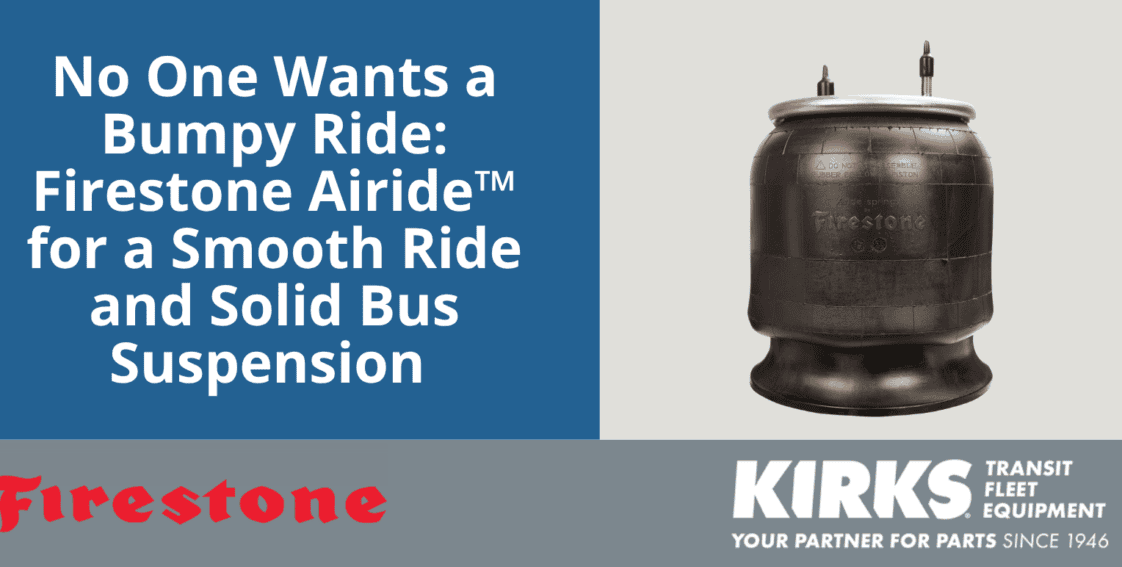
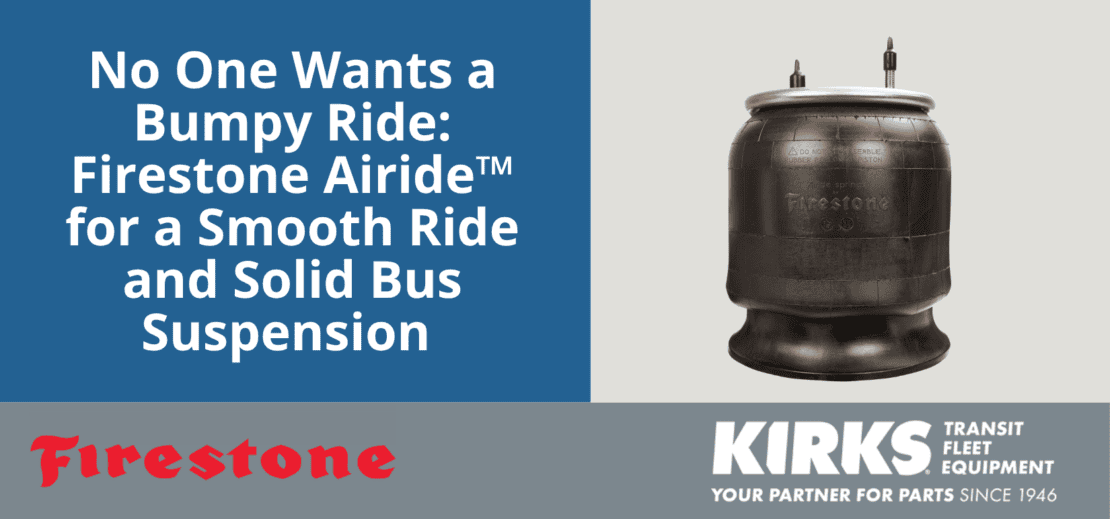
No One Wants a Bumpy Ride: Firestone Airide™ for a Smooth Ride and Solid Bus Suspension
Article Summary: Functioning as the vital posture and load-bearing joints of your bus, Firestone Airide™ suspension cushions severe road shock to protect the chassis frame, axles, and passengers from road impacts.
Built with 4-layer composite bellows, corrosion-resistant Triball/Chromium bead plates, and lightweight composite pistons, these heavy-duty air springs deliver long-lasting durability, driver comfort, and peak ride-height performance. KIRKS is your resource for Firestone’s Heavy-Duty AirideTM air springs to keep your fleet moving smoothly and affordably.
Life gives us bumps in the road, and we have ways to deal with them. But a transit bus? It’s got to go over those bumps, protect its chassis and body, and give passengers a smooth ride.
Firestone AirideTM air springs absorb punishing road impacts so the frame, cab, and passengers don’t have to. They also keep transit fleets riding smooth, safe, and on budget by absorbing road harshness to protect the chassis & frame.
The Firestone AirideTM Webinar with KIRKS
The KIRKS ToolBOX Webinar Series was pleased to cover Firestone AirideTM air springs. The webinar, titled Maximize Your Fleet Potential with Firestone AirideTM, was presented by Josée Cabral, Key Account Manager at Firestone.
Josée has 25+ years of experience specializing in commercial vehicle undercarriage systems. In this webinar, he thoroughly detailed Firestone’s AirideTM air spring portfolio, technical lookup tools, performance benchmarking, and cost/safety advantages for heavy-duty transit fleets.
“Whether you are working on heavy-duty trucks, trailers, buses, or specialty vehicles, everybody knows that a suspension is not just a group of components. It’s a very vehicle-critical system. That being said, having the right air spring can reduce maintenance costs, extend service lives, and, most importantly, keep passengers and drivers safer and more comfortable on the road.”
– Josee Cabral, Key Account Manager, Firestone Airide™
Anatomy of a Heavy-Duty Firestone Airide™ Air Spring: Recognized Leader in Benchmarking Quality
Firestone is the recognized leader in benchmarking heavy-duty air spring quality and construction. In January 2023, Firestone announced that it would be rebranding its air spring line as Firestone Airide™.
By constantly absorbing severe road shock and stabilizing heavy structural loads, Firestone Airide™ air springs protect the bus’s frame, axles, and suspension components from premature fatigue and costly mechanical stress. It’s the ultimate defense against punishment from potholed city routes, keeping the chassis intact, drivers comfortable, and the fleet out of the shop.
Maintenance Technicians and Fleet Managers rely on the quality and reliable performance they get from Firestone Airide™.
Top features that make a heavy-duty Firestone Airide™ spring tough enough for the long haul:
- 4-Layer Composite Bellows: The bellows are engineered for maximum flexibility and long life. The 4-layer composite features:
- Calendered rubber inner liner creating an airtight inner seal
- Cross-bias fabric rubber plies for structural strength.
- Second ply, set at an opposing bias angle to balance strength, flex, and expansion.
- Outer protective cover to resist road debris, abrasion, and the elements.
- Corrosion & Leak Protection: AirideTM air springs are equipped with Triball/Chromium-coated bead plates rated for a massive 200 hours of salt-spray endurance.
- Brazed Fittings: These fittings create a permanent, leak-free connection between the air fitting and top plate.
- Composite Pistons: Serving as the sturdy “footing” of the assembly, these lightweight, molded-in stud composite pistons provide stronger, cleaner installations. They are the workhorse standard for transit buses.
Anatomy of Heavy-Duty Firestone AirideTM Air Springs with the 1T Reversible Sleeve example and the Double Convoluted Example:
- Stud: Permanent high-strength bolt that anchors the air bag to the mounting bracket, suspension assembly, or vehicle’s frame.
- Combo Stud: Combination mounting stud and air fitting. This is a permanent part of the bead plate assembly, used to attach the air spring to the suspension.
- Blind Nut: A permanent part of the bead plate assembly, used to attach the air spring to the suspension.
- Air Fitting Hole: A tapped hole that provides an air entrance for the parts.
- Bead Plate: Steel plate, permanently crimped to the bellows to form an airtight assembly.
- Bellows: The air spring bellows is a flexible, airtight composite of rubber and reinforced fabric that allows the assembly to roll up and down, providing an air-cushioned spring effect within the suspension. That’s the heart of an air spring.
- Bumper (Optional): Used on many suspension applications, the bumper is a solid, molded rubber fail-safe device. In the case of sudden air pressure loss, the bumper prevents excessive damage to the suspension and vehicle. An optional component, the bumper is critical when the suspension design must limit travel.
- Piston: The lower section of the 1T Reversible SleeveTM style of Air Spring made from aluminum, steel, or fiber-reinforced composite. Provides a lower mounting arrangement for the air spring via tapped holes or studs. The composite is the most popular for commercial vehicle applications.
- Piston Bolt: Attaches the piston to the bellows assembly. When extended to the bottom of the piston, it can also attach the spring to the suspension.
- Girdle Hoop: A ring molded into the bellows of the convoluted-type air Spring.
Quick Guide: Firestone Heavy-Duty Air Spring Styles for Transit Buses
Firestone has hundreds of part numbers in their portfolio. To make it simple for customers, they group those part numbers into major categories.
Firestone Air Spring Part Number Categories:
- W26: Front steer axle applications.
- W02: Cab and seating applications.
- W01: Primary truck, trailer, and bus suspensions
Firestone engineers specialized air spring styles designed to handle specific workloads across transit and heavy-duty vehicles:
| Air Spring Style | Core Series | Primary Application | Why It Matters for Your Fleet |
| 1T Reversible Sleeve | W01 Series | Primary drive & steer axles for transit buses and heavy trucks. | The Fleet Workhorse: Engineered for high load capacity and extended stroke travel. It rolls smoothly over the composite piston to absorb heavy structural chassis impact. |
| Double Convoluted | W01/Auxiliary | Lift axles, tag axles, and auxiliary suspension systems. | Compact Load Power: Delivers immense weight-carrying strength in tight spaces where packaging clearance is limited. |
| Sleeve Designs | W02 & W26 Series | Cab mounts, driver seating (W02), and front steer isolation (W26). | Driver Fatigue Reduction: Specifically tuned for high-frequency vibration isolation, keeping your drivers comfortable, alert, and safe behind the wheel. |
Common Questions about the Firestone AirideTM and Air Spring Suspension
Q. What is the most critical operational factor in bus suspension?
A: Ride Height
Ride height is the OE-specified distance from the bottom of the frame to the center of the axle. Ride height is the most critical factor because running off-spec causes premature bottoming out or overextension, ruining suspension geometry and airbag life.
The Importance of Ride Height in Air Ride Suspensions
Ride height is a critical dimension for maintaining the proper geometry of the vehicle’s suspension. By definition, ride height is the specific distance between the bottom of the frame and the center of the axle.
The original equipment (OE) manufacturer sets this exact measurement, not the air spring manufacturer. The OE manufacturer provides the required specs and operating parameters, and the air springs are built to match those exact requirements.
Setting the correct ride height ensures the suspension system and air springs perform at peak efficiency.
Operating with a ride height that is too short or overextended compromises the entire system’s performance:
Too Low: Causes the suspension to bottom out repeatedly.
Overextended: Forces the air springs to operate outside their intended design limit.
Accurate ride-height measurement is non-negotiable for maintaining optimal air ride suspension performance.
Q. What is the top reason for failure and how can preventative maintenance help?
A. Abrasion is the #1 Cause of Air Spring Failure (And How Preventive Maintenance Prevents It)
When it comes to air spring failures, abrasion takes the top spot, and it’s directly tied to your PM routine.
Think of the rubber bellow as the “tough skin” protecting the air spring’s core. Just like skin, if something constantly rubs against it, it wears down, thins out, and eventually gives way.
What Causes Destructive Abrasion of Heavy Duty Air Springs?
External Components: Loose air hoses, cables, or surrounding hardware rubbing against the rubber of the air spring.
Debris: Road grit and buildup getting caught where it shouldn’t be.
Dirty Pistons: On reversible sleeve-style air springs, the flexible bellow continuously rolls up and down the piston. If debris builds up on that piston surface, it acts like sandpaper and wears down the rubber over time.
The Firestone AirideTM Preventative Maintenance Solution: A Simple Visual Inspection
Preventing abrasion failures is simple, quick, and highly effective during routine undercarriage inspections:
Check Clearance: Look at the airbags and ensure there is enough free space between the bellow and any surrounding components. If something is riding too close, adjust it or clear the space immediately before it wears a hole through the rubber.
Keep Pistons Clean: Ensure the piston surface is clear of debris so the bellow can roll smoothly without grinding against grit. A few seconds spent checking clearance under the bus can prevent an unexpected failure on the route!
Q. Is the Firestone company reliable when it comes to the AirideTM?
A. Yes, Firestone is the recognized leader in air spring suspension.
Firestone patented the very first air spring suspension back in 1938. After more than 80 years of continuous research and patented upgrades, the AirideTM legacy now cushions everything from heavy-duty commercial trucks, trailers, and transit buses to off-highway equipment and high-tech electric vehicles (EVs).
Firestone’s Three Core Segments
To serve modern transportation needs, Firestone structures its air spring production across three dedicated market segments:
- Consumer Automotive: OE and aftermarket comfort solutions for light-duty trucks and passenger vehicles.
- Heavy-Duty Commercial Vehicles: The heart of transit bus, heavy truck, and trailer suspensions—distributed straight to your shop floor through KIRKS.
- Off-Highway & Fluid Power: Heavy-grade industrial applications built to survive the harshest environments in construction, agriculture, and rail equipment.
Firestone’s Williamsburg Backbone
Firestone’s engineering strength comes to life in Williamsburg, Kentucky; it’s the domestic manufacturing backbone of Firestone’s air ride production since the 1980s.
To keep up with massive fleet demand and eliminate supply chain headaches, the facility recently added a massive 150,000-square-foot distribution center.
Ordering the Firestone AirideTM for Transit Buses
Instead of getting stuck in the OEM overpriced “parts trap” or rolling the dice on questionable knockoffs, KIRKS gives your maintenance team direct access to Firestone’s legendary engineering, delivering high-performance Approved Equal™ savings without sacrificing fleet uptime.