
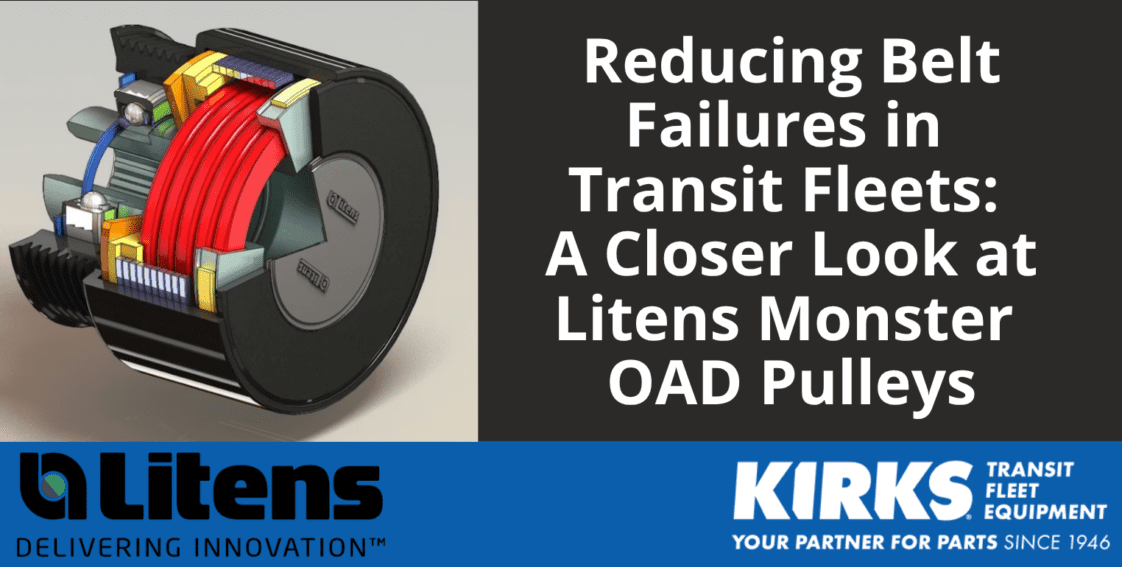
Taming the Belt-Drive Beast: Why Transit Fleets are Switching to the Litens Monster OAD
One of the most persistent “headaches” in the shop is premature belt failure. It’s often considered an unavoidable part of the job. But it doesn’t have to be. By upgrading to the Litens Monster OAD, many fleets are finding they can finally escape the cycle of constant belt replacements.
Just ask Rob Bruhn, a KIRKS Account Executive, who recently saw this in action:
“Last week, I stopped by the garage of a Michigan transit authority, where the maintenance manager kept experiencing belts breaking.
He told me that since he started using the Litens Monster OAD, he hasn’t experienced a single belt break on those buses. He said, ‘It’s saving a boatload of money, and we’re so glad to see that issue gone.”
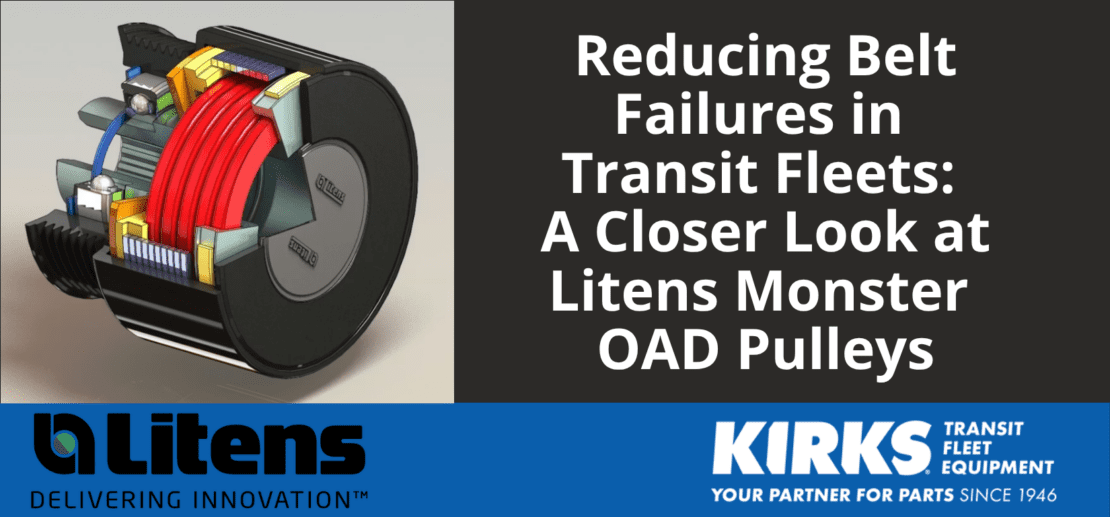
The Heart’s Sturdy Tendon: The Pulley System
In other posts, we’ve described the alternator as the heart of your bus’s electrical system. To take that analogy further, the pulley is like the heart’s tendon. We’ve all heard the phrase “pulling on heartstrings” (there are string-like tendons in the human heart). In a bus, those strings (belts) are the vital connections that keep the heart (alternator) pumping and the body (your bus!) moving.
In the brutal world of transit, those belts are working overtime. Constant idling, low RPMs, and frequent 1-2 shifting create “torsional vibrations.” These act like sudden, violent tugs on the system.
If the tendon (belt) is too stiff (like a standard solid pulley), those tugs travel straight into the heart, causing a mechanical “arrhythmia” that vibrates the belt to death.
Standard Pulleys vs. The Litens Monster OAD
A standard solid pulley is a rigid piece of metal that doesn’t care about your belt’s feelings. Every time the engine pulses or shifts, that solid pulley yanks the belt with zero “give,” leading to belt squeal, tensioner wear, and eventual breakage.
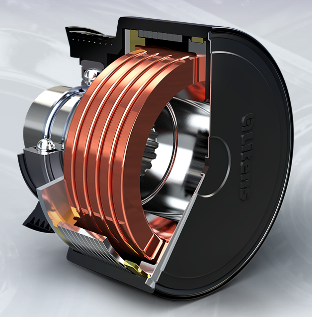
The Litens Monster OAD (Overrunning Alternator Decoupler) is a different beast entirely. Designed specifically for the heavy-duty cycles of transit buses, it doesn’t just sit there; it actively manages engine energy. Think of it as a shock absorber for the entire accessory drive.
OAD vs. OAP: What’s the Difference?
You might hear people talk about “one-way clutches” or OAPs (Overrunning Alternator Pulleys). While they are better than a solid pulley, they only do half the job:
- OAP (The “Coaster”): Like a bicycle hub, it allows the alternator to “coast” when the engine slows down, which helps quiet that annoying shutdown squeal.
- OAD (The “Triple Threat”): The Litens Monster OAD does everything an OAP does, but adds a tuned isolation spring. This spring absorbs the “shivers” (vibrations) of the engine before they ever touch your belt. It’s the difference between running a marathon in wooden clogs or high-end athletic sneakers.
Why the Monster OAD is Built for Transit
Front-end accessory drive (FEAD) failures are more than just a repair—they are a direct hit to your uptime. A failed belt means a missed route and a roadside service call. The Monster OAD addresses the root cause of belt failure: the massive rotational inertia of large, heavy-duty alternators resists the rapid speed changes of a transit engine.
Key Monster OAD design elements include:
- Tuned Isolation: Specifically calibrated for the low-RPM vibration of bus engines.
- Internal Ball Bearings: Heavy-duty assembly for long-lasting rotation.
- Protective Cap: A vital seal that keeps lubrication in and road grime out.
- Dual Configurations: Available in both splined and keyed designs to match common alternator setups like C.E. Niehoff (CEN), KIRKS KA500 (Replacement for EMP Power450 and Power535 alternators), and Delco Remy.
Where Fleets See the Biggest Impact with the Monster OAD
When you stabilize the belt drive, the “domino effect” of component failure stops. These improvements translate directly to fewer road calls, reduced unplanned maintenance, and a much lower total cost of ownership.
| Feature | Specification / Benefit Litens Monster OAD |
| Available Models | 920101 (Splined) & 920102 (Keyed) |
| Belt Life | Can triple the life of your belts |
| Tensioner Life | Can double the life of your tensioners |
| Operating Temp | Reported 20% reduction (Heat kills rubber!) |
| Fuel Economy | Potential gains of up to 5% |
OAD Monster Preventive Maintenance
Even a tough “Monster” needs a check-up. We recommend inspecting the OAD whenever you’re doing routine engine service. Watch (and listen) for these red flags:
- The “Post-Shutdown Buzz” – If you hear a buzzing sound right after the engine stops, the internal bearings may be failing.
- Belt “Hop” or “Squeal – If the belt is jumping or chirping during shifts, the pulley has lost its ability to isolate vibrations.
- The Missing Cap – Never run without it! If the cap is gone, the grease is purging, and your pulley is on borrowed time.
The “Package Deal” Note: When it’s time to replace a worn belt, don’t slap a new one on a tired OAD. You wouldn’t put brand-new tires on a car with broken struts. OADs are wear parts, and replacing the pulley with the belt is critical for optimal performance and longer belt & tensioner life.
When to Consider a Pulley System Upgrade for Your Fleet
If you are seeing frequent belt replacements, repeated tensioner failures, or visible belt movement during shifts, you have an underlying vibration problem. Replacing “like-for-like” solid pulleys will only resolve the symptom, not the cause.
Note: Not all pulleys are interchangeable. Selecting the correct part number for your specific engine/alternator is critical for the belt to function correctly. Talk with a KIRKS parts specialist today to find the right Monster OAD for your fleet.
Escape the Parts Trap
KIRKS is your Partner for Parts. We know that your work keeps people moving safely. You deserve parts that are as dependable as you are.
By switching to the Litens Monster OAD, you’re giving the “heart” of your bus the pulley system it needs to stop “skipping beats” and perform with Approved Equal™ reliability.
Ready to stop the belt-breakage cycle? Contact us for a quote today!