

BulletProof Diesel EGR Coolers: H-Core Technology is the Ultimate Upgrade
The Exhaust Gas Recirculation (EGR) cooler is a frequent headache for transit technicians. When an OEM EGR cooler cracks, it causes coolant loss, white smoke, and even catastrophic engine damage.
The EGR Cooler Graveyard in Transit Garages
We’ve seen the “EGR cooler graveyards” when we visit customers who’ve been stuck in the bus manufacturers’ parts trap. Frustration levels run high with frequent failures of standard EGR coolers.
Recently, we did an online search for EGR cooler failures and found three common industry-wide frustrations that maintenance teams frequently struggle with.
These are the 3 common “headaches” KIRKS aims to solve with Bulletproof Diesel EGR Coolers:
- Fouling and Clogging: Standard EGR coolers are highly susceptible to “fouling.” This refers to a buildup of soot, organic compounds, and water that can drop thermal efficiency by 30% in a very short time (Abd-Elhady et al., 2011).
- Thermal Stress: EGR coolers must handle massive heat rejection, often adding 20% to 50% additional load to the engine’s cooling system. This leads to cracking and internal leaks in lower-quality parts (Wambsganss, 2000).
- Performance Loss: A failing EGR system often results in uneven idling, increased fuel consumption, and potential engine immobilization (Wozniak et al., 2022).

The Warning Signs of an EGR Cooler Failure
Because the EGR cooler acts as your engine’s thermoregulation system, keeping those blistering exhaust gases from cooking the engine from the inside out, a failure here is bad news. When this system breaks down, your engine loses its ability to stay cool under pressure.
Unfortunately, EGR cooler issues are notoriously sneaky. By the time you notice the most obvious symptoms, the damage may already be done, leaving your team with the cost of a massive repair or engine failure.
Keep your eyes peeled for these two major red flags:
- White Smoke Billowing from the Exhaust: If your bus looks like it’s auditioning for a rock concert with clouds of white smoke pouring out of the tailpipe, you’ve got a problem.
This happens because a cracked internal tube is allowing coolant to leak directly into the exhaust stream, where it instantly vaporizes into thick white steam. - The Mystery Loss of Coolant: If your maintenance team is constantly topping off the coolant reservoir, but you can’t find a puddle on the shop floor, the engine is likely “drinking” it.
A fractured EGR cooler will swallow coolant and send it straight through the combustion chamber.
A word of caution: Technicians can misdiagnose an issue and think that it’s the EGR cooler, so they toss it. Sometimes they have head gasket issues, or they may have a leak in the system that’s causing a loss of coolant.
Escape the Frustration of “Groundhog Day” EGR Cooler Repairs with Bulletproof Diesel’s H-Core Technology
If you spot these signs, don’t just replace a broken factory part with another identical factory part. That’s because that’s just waiting for the exact same headache to happen again.
Why are you replacing the same EGR cooler every 6 months?
When you’ve got buses down, why are you waiting on EGR cooler backorders?
If you are, then you’re stuck in the “parts trap.” KIRKS carries Bulletproof Diesel EGR Coolers to keep your people moving.
BulletProof Diesel is a company based in Arizona, with patented H-Core technology that has transformed required EGR coolers for the transit industry. Their engineered, patented solution fixes the fundamental design flaws of standard OEM coolers.
Here’s how: We’ve got a breakdown of why BulletProof Diesel EGR coolers are the ultimate upgrade for your fleet’s engines.
OEM vs. BulletProof Diesel: The Engineering Breakdown
Standard EGR coolers rely on thin, delicate radiator-style tubes that are prone to fatigue and cracking under intense thermal stress. When the cooler is too rigid, the heat from the exhaust (1,000°F+) forces the metal to expand. If it can’t move, it cracks, like a bone snapping under too much pressure.
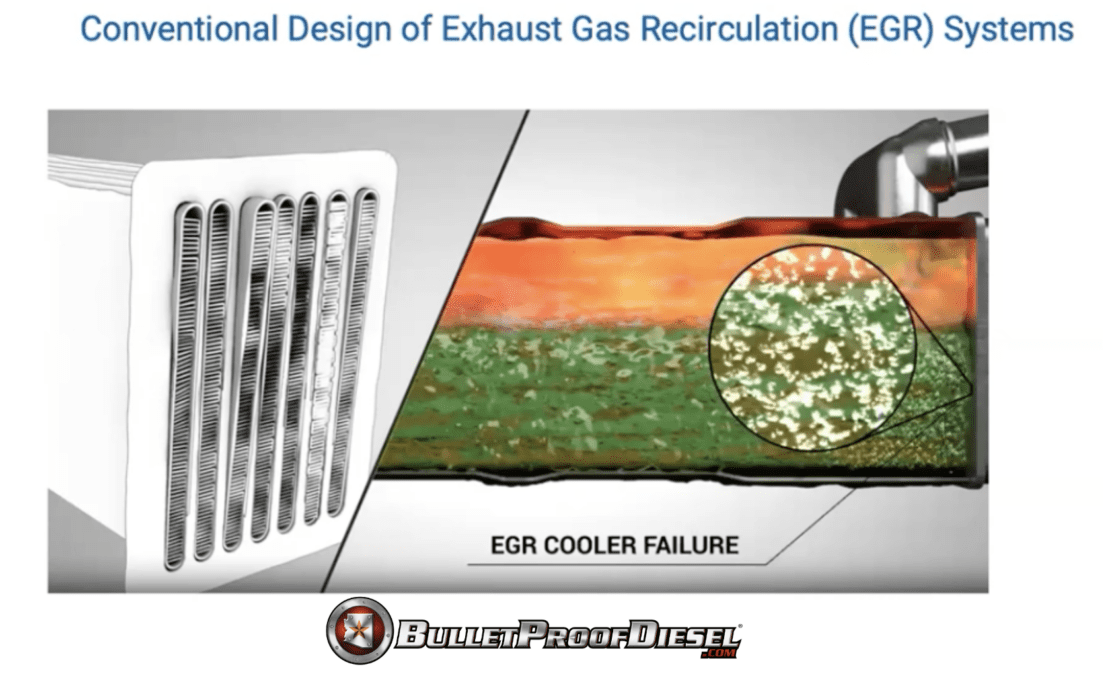
BulletProof Diesel replaces that weak link. H-Core patented technology instead employs heavy-duty stainless steel, hollow tubes in a rugged coaxial design, allowing the unit to expand and contract without breaking.
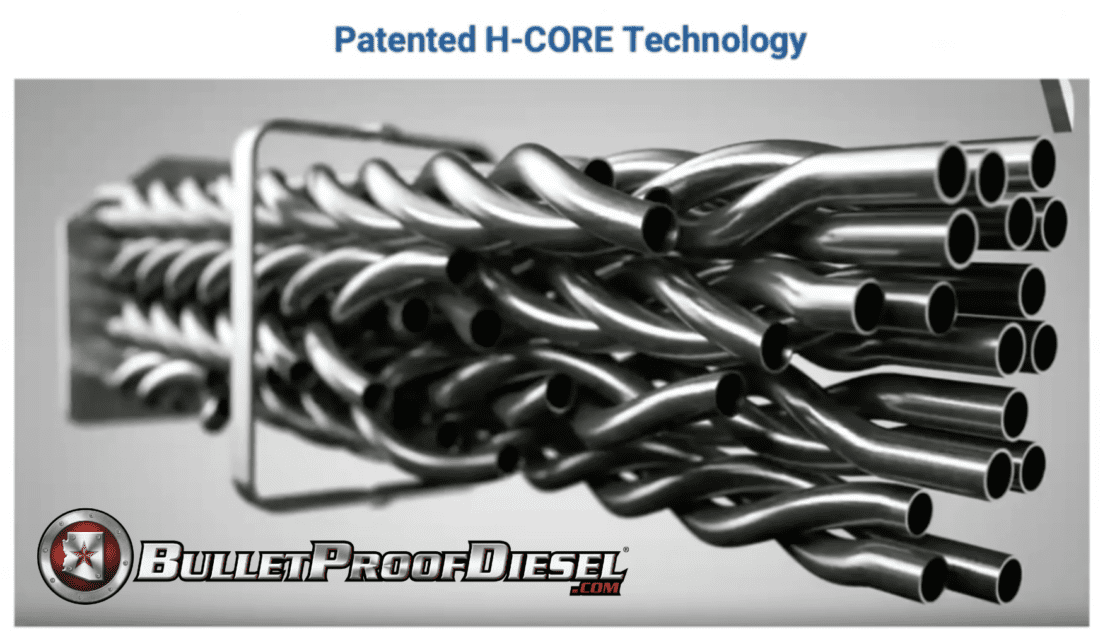
The Engineering Difference: EGR Cooler Fins vs. BulletProof
Understanding the engineering difference between a standard factory component and a true upgrade makes the choice clear.
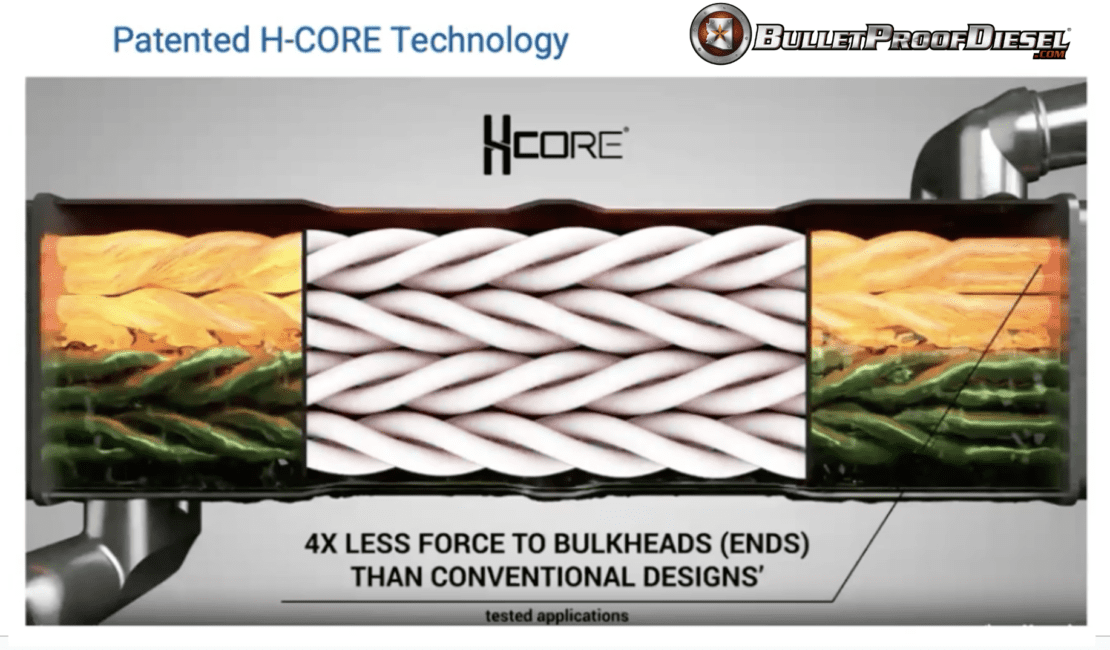
The H-Core Design: The braided stainless steel tubes allow expansion and contraction, resulting in much less stress (4x less force) at the bulkheads of the Bulletproof EGR Cooler.
Here is how standard OEM EGR coolers stack up against the BulletProof Diesel H-Core heavy-duty design:
- Patented Solid-Tube Construction: The internal design of standard EGR coolers relies on thin, folded radiator-style fins that resemble a delicate accordion. BulletProof Diesel completely re-engineered this weak point by replacing those fragile fins with heavy-duty, flexible stainless steel tubes. This eliminates the #1 cause of EGR failure: thermal stress cracking.
- Clogging-Resistant Geometry: Because factory units use tightly packed fins, they pose a high risk of clogging, as soot and carbon easily plug narrow passageways. BulletProof units feature an open-tube design that keeps the clogging risk low, allowing exhaust debris to pass freely through the cooler, preventing the restricted flow that triggers dashboard codes and limp mode.
- Thermal Stress: Standard coolers are notoriously prone to cracking and leaking because they can’t handle the intense heat cycling of day-to-day transit routes. BulletProof Diesel coolers are built to tolerate extreme thermal expansion, meaning they can flex and take the heat without failing.
- Reliability: With an EGR cooler replacement, you’re looking at a recurring maintenance expense and a failure waiting to happen all over again.
Upgrading to a BulletProof unit gives your team a fix that is engineered to outlast standard EGR coolers. - Spec Standards: While standard EGR coolers merely meet base OEM requirements, BulletProof Diesel units are true Approved Equal™ parts. (See how Approved EqualTM changes the parts landscape), This is because they are engineered to specifically fix known design flaws and exceed OEM specifications.
- Drop-in Replacement: Bulletproof Diesel remanufactures EGR coolers with the same housing, so technicians will have no concerns with easy installation.
- Tested Confidence: These components are rigorously tested so your maintenance team can install them with total confidence at a fraction of the lifetime cost.
The Real Cost: Labor vs. Part Price. If shopping for the best price is the priority, savings on an inferior part are erased the moment a tech has to pull the turbo and manifold again two months later. For more tips and information on EGR coolers, see Staying Cool Under Pressure.
WATCH: Bulletproof Diesel and KIRKS “Darn Near Bulletproof Diesel EGR Coolers
In this edition of the KIRKS ToolBOX webinar series, Mike Kirkman, KIRKS, and John Risch, Bulletproof Diesel, discuss the reliability the EGR Cooler H-Core technology brings to maintenance technicians. See it on the KIRKS YouTube channel here.
Bring reliability to your fleet: Connect with a KIRKS Parts Specialist Today to upgrade your engine.
References
Abd-Elhady, M. S., Malayeri, M. R., & Müller-Steinhagen, H. (2011). Fouling Problems in Exhaust Gas Recirculation Coolers in the Automotive Industry. Heat Transfer Engineering, 32(3-4), 248–257. https://doi.org/10.1080/01457632.2010.495612
Abd-Elhady, M. S., Malayeri, M. R., & Müller-Steinhagen, H. (2010). Fouling problems in exhaust gas recirculation coolers in the automotive industry. Heat Transfer Engineering, 32(3–4), 248–257. https://doi.org/10.1080/01457632.2010.495612
Wambsganss, M. W. (2000). Thermal management for heavy vehicles (Class 7-8 trucks). Office of Scientific and Technical Information (OSTI). https://doi.org/10.2172/754232
Wambsganss, M. W. (2000). Thermal management for heavy vehicles (Class 7-8 trucks). https://doi.org/10.2172/754232
Wozniak, M., Siczek, K., Zakrzewski, S., Just, P., Ozuna, G., & Onescu, C. (2022). Effect of deposition of carbon deposits on charge flow in EGR valve in CI engine. Combustion Engines, 192(1), 26–35. https://doi.org/10.19206/ce-150503