
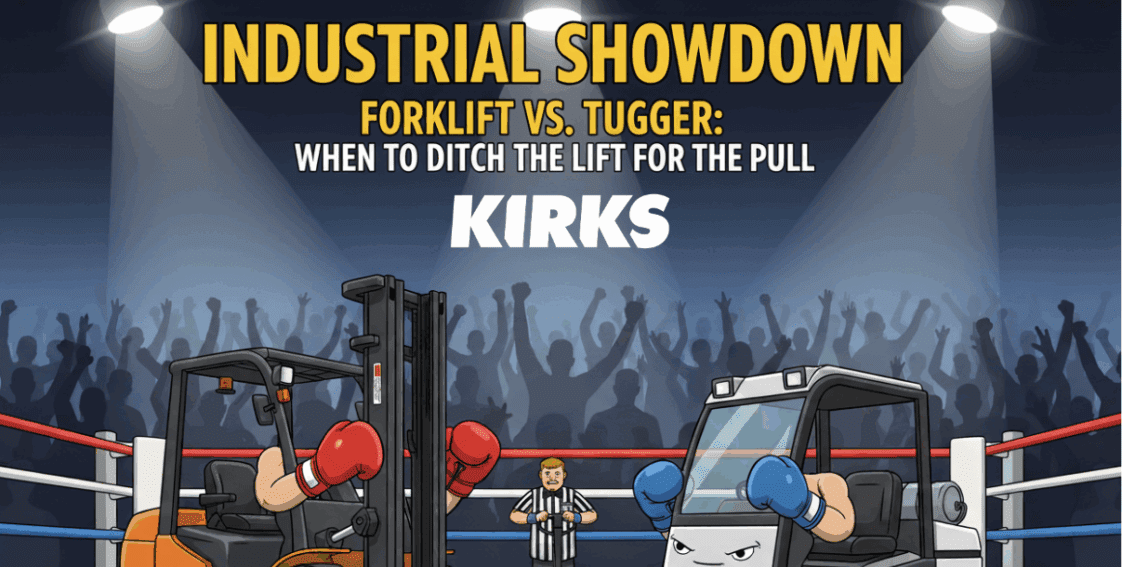
Tugs vs. Forklifts: When to Ditch the Lift for the Pull
Heavy material handling is a constant challenge in industry and manufacturing, and your team doesn’t have time for material handling headaches.
For years, the forklift has been the king of the plant floor. But when it comes to moving material, not just lifting it, that old approach keeps your team exposed to more safety risks, inefficiency, and high maintenance costs.
It’s time to ask the smart question: Is the standard forklift the right tool for the job, or is a diesel or electric tug the smarter choice?
The answer, for most line-feeding and heavy material moving applications, is the tug.
The reasons a tug is often the preferred vehicle will be influenced by the application, but when it’s right, the benefits of a tug are a heavy lift.

Here are our top three reasons why your operation could benefit from a tug for heavy material handling:
1. Safety: Less Lift, Less Risk
Safety for your team is a priority. Forklifts introduce unique hazards that electric tugs virtually eliminate.
- Visibility: Forklifts often carry tall, bulky loads that severely obstruct the operator’s view. These blind spots can be hazardous around busy maintenance crews. A tug’s load is carried behind the operator, providing the operator with complete, clear visibility.
- Stability: A forklift is designed to lift heavy loads to a high position. Lifting the load raises the center of gravity, increasing the risk of tip-overs. Even on slight inclines or turns made too quickly, tipping is a potential hazard. Tugs keep the load low and distribute the weight across multiple trailers, providing superior stability.
- Operator Training: Tugs are far simpler to operate, and training can be completed in a fraction of the time required for a forklift. By reducing the complexity of the necessary training or the certification needed for a heavy-duty forklift, the tug has an obvious advantage.
2. Efficiency: Making Every Inch Count
On the plant floor, real estate is premium. Aisle space isn’t just a convenience; it dictates workflow speed.
- Aisle Space: A large, counterbalanced forklift requires massive turning radii and wide aisles. Tuggers utilize the advantage of pull, similar to a train of small carts or trolleys, which follow a much tighter path with a superior turning radius. This allows your team to reclaim valuable shop floor space and dedicate it to revenue-generating work.
- Productivity: Tugs are built for high-volume, repetitive movement. They can pull multiple carts with heavy loads on a single trip. In contrast, a forklift often moves one pallet at a time. This significantly reduces the number of trips and wait times.
- Improved Air Quality: Eagle Tugs are available in electric models. When indoor air quality is essential, electric tugs are the workhorses that don’t leave a trail.
For a deeper look at how these machines optimize workflow, we provide an overview in Tuggers for Industrial, Automotive, and Transit Applications: A High-Level Overview.
3. Maintenance: The Cost of the Lift Trap
This is where the financial difference truly hits your budget and helps you escape the parts trap. The heavy-duty nature of lifting, tilting, and stacking puts massive strain on a forklift’s components.
| Component Strain | Forklift (Lift) | Electric Tug (Pull) |
| Hydraulics | High stress requires regular hose/seal/pump maintenance | Minimal to none for most models with a 2000-hour PM Program |
| Transmission/ Axles | Heavy loads, frequent maneuvering, and high lifting strains can lead to complex and costly repairs for axles and gearboxes. | Designed for steady, horiztontal pulling, this means less wear and tear on compomnents. |
| Tires | Solid tires often wear unevenly due to heavy counterweights and tight turns, requiring frequent, specialized replacement. | Simple, easy-to-replace tires, designed for movement, not high-load standing. |
Forklifts have intricate, high-cost systems with wear points (like masts, hydraulics, and complex steering axles) that constantly need attention. Tugs are simpler machines dedicated to one function, making them a much less maintenance-intensive solution. This translates directly to reduced downtime and lower maintenance parts spend.
We also detailed the benefits of this simplicity and the shift away from complex machines in Pulling Ahead: How Electric Tugs (a.k.a. Tow Tractors) Are Transforming Industrial Operations.
Your Partner for the Better Process
At KIRKS, we don’t just sell parts; we are your partner for parts and your resource for better fleet maintenance solutions. Positioning an electric tug as the primary material mover is a smarter, less maintenance-heavy Approved Equal™ process for your facility.
The tug represents dependability. When you ditch the lift for the pull, you’re not just trading a piece of equipment; you’re investing in a system that is safer, more efficient, and dramatically less expensive to maintain.
Ready to level up your operation with an Eagle electric or diesel tug? Start with the KIRKS Tug Inquiry, and a product specialist will contact you. Our team will then conduct a Custom Site Survey to recommend the Eagle Tug model that best meets your performance requirements.